
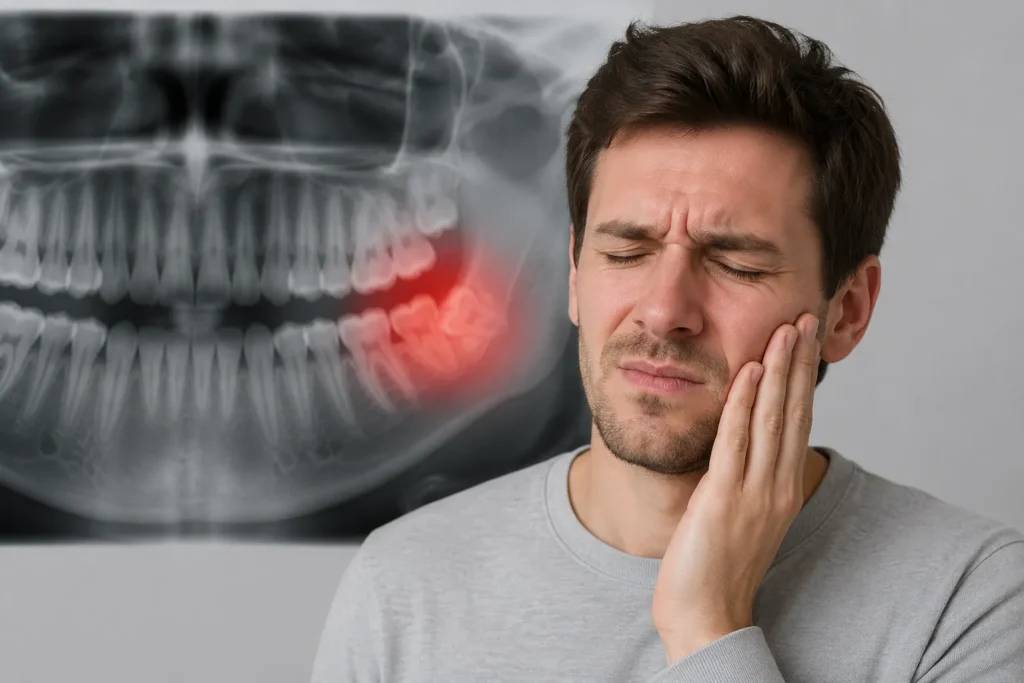
Wisdom teeth tend to arrive uninvited, usually somewhere between your late teens and mid-twenties, and they rarely announce themselves gently. One day your jaw is fine, and the next there is a dull ache at the very back of your mouth that gets worse every time you eat, yawn, or lie down. Here is what actually helps, why it flares up in the first place, and when it stops being something you can manage at home.
Why Wisdom Teeth Hurt in the First Place
Most mouths simply do not have enough room for a third set of molars. By the time wisdom teeth try to come through, the rest of your teeth are already in place, so the wisdom tooth often has to push through at an awkward angle, only partially break through the gum, or stay trapped beneath the surface entirely. This is called impaction, and it is the root cause of most wisdom tooth pain.
The most common problem is pericoronitis, which happens when a wisdom tooth partially erupts and a flap of gum tissue remains over part of it. Food and bacteria get trapped under that flap, and the gum becomes inflamed, swollen, and painful. It can flare up periodically, settle down for a while, then come back worse than before, which is why so many people describe wisdom tooth pain as coming and going in waves.
What Actually Helps Right Now
Warm salt water rinses. This is genuinely one of the most effective things you can do. Dissolve half a teaspoon of salt in a glass of warm water and rinse gently around the affected area for 30 seconds, several times a day. Salt water is a natural antiseptic and helps flush out the food and bacteria trapped under the gum flap, which is usually what is driving the pain.
Ibuprofen. Because wisdom tooth pain is largely inflammatory, ibuprofen tends to work better than paracetamol on its own. Take it with food and follow the dosage on the packet. If it is not quite enough, you can alternate with paracetamol (one, then the other two hours later) for more consistent coverage.
A cold compress on the outside of your jaw. Ten minutes on, ten minutes off. This helps bring down swelling, especially useful if one side of your face feels puffy or tender to touch.
Antiseptic mouthwash. Chlorhexidine mouthwash (sold as Corsodyl in most UK pharmacies) can help control the bacteria around an inflamed wisdom tooth. Use it as directed on the bottle rather than as a substitute for salt water rinsing, which is gentler and can be used more often.
Keep the area as clean as you can. It sounds obvious, but a soft-bristled toothbrush and gentle rinsing after meals stops food from building up under the gum flap, which is often what triggers a flare-up in the first place.
What Does Not Help (And Sometimes Makes It Worse)
Clove oil has a long history as a folk remedy and does contain eugenol, a compound with mild numbing properties. In practice, applying it directly to inflamed gum tissue often stings more than it soothes. If you want to try it, use the smallest amount possible on a cotton swab rather than rinsing with it.
Very hard or chewy food on the affected side will aggravate an already irritated gum flap. Stick to softer food and chew on the opposite side while it settles.
Poking at it with a toothpick or your tongue. It is tempting to keep checking on the sore spot, but disturbing an already inflamed area of gum tends to prolong the irritation rather than help it.
How Long Does Wisdom Tooth Pain Usually Last?
A mild flare-up of pericoronitis often settles within a week to ten days with good home care. But it is worth being honest with yourself about the pattern. If the pain keeps returning every few weeks, that gum flap is not going away on its own, and each flare-up is a sign of the same underlying problem rather than a new, unrelated issue. Many people manage a partially erupted wisdom tooth for months or even years with recurring discomfort before finally having it looked at, when a single assessment could have identified whether it needs to come out.
When Wisdom Tooth Pain Needs a Dentist, Not Just Painkillers
Home care is genuinely useful for a mild flare-up, but certain signs mean you should not wait it out:
Swelling in your face, jaw, or neck. This suggests the infection is spreading beyond the immediate area and needs treatment, not just pain relief.
Difficulty opening your mouth fully (a symptom called trismus). This happens when swelling and inflammation affect the surrounding jaw muscles and is a sign the problem has progressed.
A fever or feeling generally unwell. A dental infection is still an infection, and your body responding to it systemically is a sign it needs proper treatment.
Pain that is severe or does not respond to ibuprofen and paracetamol together. If over-the-counter painkillers are not touching it, that is a sign the infection or inflammation is more significant than a typical flare-up.
A bad taste or pus around the gum. This indicates active infection under the gum flap that needs to be treated, usually with a clean and possibly antibiotics, rather than left to resolve on its own.
If you have severe facial swelling that is affecting your breathing or ability to swallow, that is a medical emergency. Go straight to A&E at Leicester Royal Infirmary (Infirmary Square, LE1 5WW, adult emergency entrance on Aylestone Road) rather than waiting for a dental appointment.
What a Dentist Can Actually Do About It
The right treatment depends on what is causing the pain and how often it is coming back.
Cleaning under the gum flap. For a straightforward case of pericoronitis, a dentist can clean thoroughly under the inflamed tissue, which often brings quick relief and reduces the immediate infection.
X-rays to assess the tooth’s position. This shows whether the wisdom tooth is impacted, at what angle it is growing, and whether it is likely to cause repeated problems in future. This is the piece of information most people are missing when they have been managing recurring pain for months without knowing why.
Antibiotics, if there is a spreading infection, to bring it under control before any further treatment.
Referral or extraction, if the wisdom tooth is impacted and likely to keep causing problems. Not every wisdom tooth needs to come out, but a recurring pattern of pain and infection is usually a sign that it will keep flaring up until it does.
Night and Day Emergency Dentist Leicester
If wisdom tooth pain is not settling with home care, or you want an X-ray to understand what is actually going on, Night and Day Emergency Dentist Leicester can see you the same day. The practice is in Westcotes on Narborough Road, a five-minute walk from Fullhurst Community College down Imperial Avenue, and around 200 yards up from the Narborough Road KFC heading towards the city centre. Coming via the M1, exit at Junction 21 and follow signs for Leicester City Centre onto Narborough Road.
The emergency consultation includes an examination and any X-rays needed to assess the tooth. No registration is required and walk-ins are welcome. Call 07400 400 790 or book online.
Welcome to WordPress. This is your first post. Edit or delete it, then start writing!